
Reviewed · LOS ANGELES CITY TOURS
LA Little Tokyo to Olvera St Smartphone (App/GPS) Walking Tour
LA in 75 minutes? Yes, if you love streets. This LA Little Tokyo to Olvera Street smartphone walk strings together major neighborhoods and landmarks with story-led directions, and I especially like the pause-and-explore control plus the way the narration connects sites to quick photo moments. One watch-out: GPS can occasionally land you a little off around large streets and hotels, so you may need a minute to get your bearings and then you are back on track fast.
You start at the Chiune Sugihara statue on S Central Ave, then work your way through Little Tokyo, Japanese Village Plaza, and Downtown sites before finishing at Cielito Lindo on Olvera Street. Expect about 1 to 1 hour 15 minutes, in English, with a mobile ticket and a private setup just for your group.
There is no live guide and no food included, so this is best if you like self-guided walking and headphone audio. It also helps to bring a charged phone, since the tour is fully dependent on the app.
Key things to know before you start
- Pause when you want. The GPS-guided flow lets you stop, look, and move at your pace.
- Photo-friendly stops with real context. You get story as you walk, not just signage.
- Japanese LA to Mexican LA in one loop. The route covers Little Tokyo, Japanese Village Plaza, and then Olvera Street.
- A finale at a famous taquito stand. The ending is built around Cielito Lindo’s origin story and how the food is made.
- One stop hits heavier themes. The exterior Chinese American Museum segment covers Chinese riot history and murders, so be ready for that tone.
From Chiune Sugihara statue to Cielito Lindo taquitos
This walk feels like a guided route through LA identity shifts, from Japanese American presence in Little Tokyo to the Mexican marketplace story on Olvera Street. The route is designed so you are not just hopping between landmarks. You are moving along corridors where the city’s layers show up in architecture, street layout, and community memory.
Starting at the Chiune Sugihara statue on 192 S Central Ave gives you a neat entry point. It is a clear anchor for the app, and it signals you are heading into a Japanese LA story line right away. The final stop at Cielito Lindo on E 23 Olvera St works like a built-in reward. You end where the atmosphere is festive, the walk’s narrative threads converge, and you can grab a taquito while hearing how the place got started.
If you are short on time, this matters. A one-hour to one-hour fifteen-minute walk means you can fit it into a tight itinerary without feeling like you lost a whole day to logistics. If your travel style is “walk, read, look, then snack,” this route matches that rhythm.
A few more Los Angeles tours and experiences worth a look



Price and pacing, why $7.50 makes sense for this format
$7.50 per person is a low price, and the value comes from how the tour is built. You pay for a location-aware smartphone app that narrates multiple historic districts and major Downtown landmarks. Since the itinerary’s listed stops are free to access, you are not also paying entrance fees.
The biggest value is also the biggest trade-off. You are not buying a live guide. You are buying a self-paced, story-first route. That works well when you want flexibility, especially if your group has different interests. One person can linger on details, another can hunt down the best angles, and the app lets you manage that without waiting for a group.
Time-wise, the pacing is tight but not rushed. The stops are short at many points, which helps you keep moving through neighborhoods where traffic and crowds can slow you down. The structure also makes it easier to stay oriented, since each stop is a distinct “chapter” rather than one long blur of walking.
How the location-aware phone GPS keeps you on track
This is a smartphone GPS walking tour, so the app is the leader. That is why the reviews about the ability to pause are so important. When you can pause, you stop treating the walk like a video you must finish. Instead, you can read signage, step aside for photos, or quickly check what you are looking at before you continue.
A couple practical notes to make the experience smoother:
- Keep the screen brightness up and volume audible enough to hear narration while you walk.
- If you get turned around, do not panic. The tour is built to re-sync you within minutes.
- If you plan to stop for a bite, factor in that the tour includes no food or water. You are free to buy what you want, but the timing is on you.
One other consideration: because it is GPS-based, accuracy can vary block by block. Around large landmarks and busy streets, you might notice the directions feel a little ambiguous for a minute. When that happens, use your eyes as the backup system. Look for the landmarks named in the narration and then continue once the app lines up again.
If you prefer a printed map, a GPS-only walk is not as comfortable. But if you like following a route you can control, this is a strong setup.
Little Tokyo chapter: history, street atmosphere, and photo stops
The Little Tokyo portion is where the tour starts building the larger story arc. You are not just walking down one main street. You are seeing multiple points connected to the Japanese presence in LA, with narration that frames what you are looking at in plain language.
This stop is also a practical choice for first-time visitors. Little Tokyo tends to have clear “walkable edges,” so the app can guide you without you needing to constantly cross huge stretches. You can keep your energy for the moments you want to stop at longer.
The experience also works for mixed-interest groups. The narration is informative enough for the history-minded side of your trip, while the route is structured around visual moments that work well for photos. Think: plazas, signage, and architecture that instantly looks like what you came to see.
If you are sensitive to crowds, going earlier in the day can help. The tour’s time is short enough that you can choose a calmer window if you want the streets to feel easier to navigate.
Japanese Village Plaza and the fire tower, plus mochi and an Edo-style garden
Japanese Village Plaza is one of the spots on this walk where you can really feel the design language of the area. The itinerary calls out the fire tower specifically, which is helpful because it gives you a clear target landmark as you navigate the plaza.
This stop is also where the tour’s “small pleasures” come in. The narration points you toward the mochi side of the experience, and it also references an Edo garden. Even if you do not plan to buy anything, hearing the context makes the sights feel more meaningful, and it helps you spot what matters once you are there.
Here is a simple way to approach this stop: slow down for one minute before you scan for photos. Look at the fire tower area, then glance at surrounding details. When you do that, the narration lands better, and you do not just rush through a plaza because the app says so.





Fugetsu-Do Bakery: where the snack is part of the story
Fugetsu-Do Bakery is an easy stop to enjoy because it is both a landmark and a food destination. The tour highlights it as one of the best bakeries and includes their origin story, plus a reason this is a good place to eat.
Important practical point: the tour does not include food. So treat Fugetsu-Do as a chance to reward yourself on your own schedule. If you want to try something, this is exactly the kind of stop where a small purchase is worth it because the narration has already made you care.
Also, because this is a walking tour, it is smart to plan around what you buy. Something compact and easy to eat while walking works best. Save the “sit and linger” snacks for later if you want to keep the tour flow on pace.
If you like tasting as you learn, this is one of the strongest stops on the route.
City Hall and El Pueblo de Los Ángeles: why LA starts here
Then the walk turns toward Downtown, and that is where you get the bigger “LA origin” feeling. Los Angeles City Hall is a key chapter because the itinerary includes the construction story and a chance to get a view from the observation deck.
That viewpoint piece matters. Cities can feel abstract until you look down from a higher angle. If you take advantage of the deck when it is available, you will understand why the next stop, El Pueblo, is so foundational. The route is basically saying, LA began here, and you are still walking through the framework that shaped later neighborhoods.
At El Pueblo de Los Ángeles Historical Monument, you get the story behind the naming and see the historic park. This is one of those stops that can be short on paper and still feel big in the mind, because it reframes the city as a place with early roots, not just a cluster of modern districts.
If you enjoy architecture and civic landmarks, do not rush this section. Even if you stay in the 10-minute window, a quick pause to read and look is worth it.
Olvera Street and Calle Olvera: from Wine Street to a living marketplace
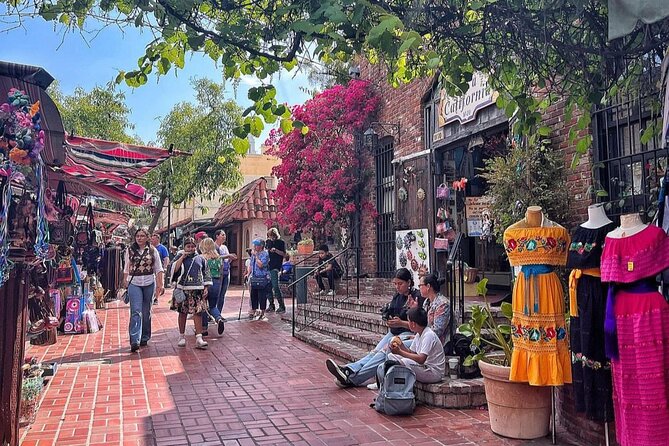
Olvera Street is the centerpiece of the Mexican marketplace story on this walk. The itinerary notes that the area was originally known as Wine Street, then extended and renamed in honor of Judge Augustín Olvera in 1877. Later, in 1930, local merchants adapted it into the colorful marketplace you can still visit today.
I like this part because it is history you can feel under your feet. You are walking through a space that evolved through real community decisions, not a static museum layout. The tour also frames Olvera Street as a festive, atmosphere-forward place, so you are not just reading dates. You are seeing how a market street functions as a social space.
Calle Olvera is the shorter “history chapter” stop right before you reach the final taquito landing zone. It is a good time to recalibrate your energy, especially if your phone battery has dipped. This is also when I suggest you keep an eye on the app’s next directions so you do not lose time when streets get busy.
The Cielito Lindo finale: why the ending works so well
The tour ends at Cielito Lindo on Olvera Street, and it is a smart way to close. The itinerary says you will hear how the stand started and how the food is made, then you walk through Olvera Street’s festive atmosphere.
This ending matters for two reasons. First, it rewards you with something you can do right away. Second, it turns the walk’s narrative into a sensory payoff. You are not leaving with only facts in your head. You are leaving with food in hand and a sense of how the place became part of the neighborhood story.
Since the tour does not include food or water, bring a plan for your own snack budget. If you want to sample, this is the best moment because you are done with the “hard” parts of the walk and can enjoy.
Chinese American Museum exterior stop: a moment with heavier themes
One stop is outside the Chinese American Museum, and it covers the Chinese riot, murders, and the history of Chinese people in LA. This is not a light detour. It is an important context stop that adds emotional weight to the route.
I appreciate that it is placed where the tour is already moving through Downtown history. The contrast helps you understand that LA’s story includes both community building and brutal violence. If you prefer a gentler itinerary, you might want to mentally prepare for this section.
This also helps you get more out of the other stops. Once you recognize that multiple communities have shaped LA through hard chapters, it is easier to see how markets, plazas, and cultural neighborhoods are responses to real historical forces.
Who this smartphone tour suits best
This experience is a good match if you:
- want self-paced walking with narration you control
- like mixing Japanese LA and Mexican LA landmarks in one run
- enjoy history but do not want a lecture format
- travel as a group with different interests, since the route supports both reading and photo moments
It may be less ideal if you:
- dislike GPS directions and prefer human-led guidance
- do not want to rely on your phone battery and audio
- expect food and water to be part of the price
Because this is a private tour for your group, it also works when you want less friction than a standard group tour. The flip side is you are also relying on the app rather than someone to adjust if you stumble.
Quick checklist to make the walk smooth
Before you start, do a simple prep so the app works well:
- Charge your phone fully, or bring a small power bank.
- Have headphones ready for clear audio.
- Wear shoes you trust, since this is a continuous walking loop.
- Bring water, since the tour does not provide it.
If you follow those basics, the tour becomes what it is meant to be, an easy, story-based way to connect multiple LA neighborhoods in a short window.
Should you book this LA Little Tokyo to Olvera St smartphone walk?
If you want an efficient route with clear stop chapters, this is an easy yes. The strong points are the ability to pause when you want, the way the narration balances history and sights, and the payoff ending at Cielito Lindo. At $7.50, you are paying for convenience and context, not for a live guide or included meals.
I would skip it only if you hate phone-based GPS, if you want food included, or if you want a lighter tone. Otherwise, it is a smart way to turn an hour into a real sense of place, from Little Tokyo streets to Olvera Street’s taquito finish line.
FAQ
How long is the LA Little Tokyo to Olvera St smartphone walking tour?
The duration is about 1 hour to 1 hour 15 minutes.
How much does the tour cost?
It costs $7.50 per person.
Where do I start and where does the tour end?
You start at the Chiune Sugihara statue, 192 S Central Ave, Los Angeles, CA 90012. The tour ends at Cielito Lindo, E 23 Olvera St, Los Angeles, CA 90012.
What’s included in the price?
You get a location-aware smart phone app walking tour that helps you discover the story behind buildings in historic areas. It also includes a mobile ticket.
Is there food, water, or entrance fees included?
No. The tour does not include food, water, entrance, or people.
What language is the narration in?
The tour is offered in English.
More Self-Guided Tours in Los Angeles



More Tours in Los Angeles
More Tour Reviews in Los Angeles
Not for you? Here's more nearby things to do in Los Angeles we have reviewed









Los Angeles City Tours, compared.
 ★ 4.6Warner Bros. Studio Tour HollywoodFrom $767,191 reviews
 ★ 5.0Full-Day Iconic Sights of LA, Hollywood, Beverly Hills, Beaches and MoreFrom $996,147 reviews
 ★ 5.0Full-Day LA Tour: Santa Monica, Hollywood and Beverly HillsFrom $952,431 reviews
 ★ 3.7Hop-On Hop-Off Bus Tour with Audio GuideFrom $512,030 reviews
 ★ 5.0Half Day Best of Los Angeles Guided City TourFrom $691,966 reviews
 ★ 4.7Half-Day Best of LA TourFrom $591,778 reviews
 ★ 5.0Shared 3 Hour Los Angeles TourFrom $501,686 reviews
 ★ 4.1Hollywood & Celebrity Homes Open-Air Bus TourFrom $291,624 reviews
Browse the lists this tour appears in