
Reviewed · LOS ANGELES CITY TOURS
LA Arts District Tour
Los Angeles has a second face, and it is painted. This Arts District walk-and-talk tour connects downtown murals to the people and ideas that shaped the area, with stops at well-known art spaces and local-minded creative corners. If you like street art plus real-world context, this is a smart way to get oriented fast.
I especially like how the stops are small, focused moments rather than rushed photo ops, so you can actually look at materials and technique. The best part is the guide style, with lots of practical LA context, including how the district evolved over time. One thing to consider: it is a good-weather experience, and one museum stop can depend on the day and time.
Key Highlights Worth Your Time
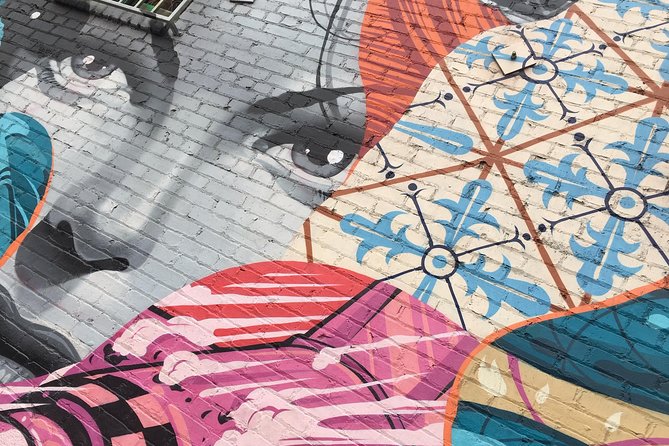
- Container Yard’s mural collage and a quick lesson in how this enclave changed with the people using it
- Colette Miller GlobalAngelWingsProject for a memorable, easy-to-see moment right early in the walk
- Joel Bloom Square as a short but satisfying breather stop that keeps the energy up
- Art Share L.A. as a creative collective stop, great if you like art spaces with a community feel
- Hauser & Wirth for a step into a major gallery setting, still within the neighborhood walk
Downtown LA Murals, Galleries, and a Tour That Moves With You

This is the kind of Los Angeles Arts District tour I recommend when you want culture, but not chaos. You are in downtown Los Angeles, yet the vibe here is more about creativity in motion than big sightseeing machinery. Expect a 2-hour private experience that blends outdoor street art sightings with quick indoor moments at art institutions.
The structure matters. Short time at each stop keeps you looking, not just traveling. And because it is private, you can ask questions in the moment. That is where a tour like this pays off: it helps you read the neighborhood, instead of just collecting images.
You can also read our reviews of more tours and experiences in Los Angeles.


Price and What Your $50 Actually Buys
At $50 per person for about two hours, the value comes from two things: access to a guided route and the fact that the planned admissions are listed as free at the stops. You also get bottled water, which is small, but it helps when you are out for a couple hours under real Southern California conditions.
Is it a “museum marathon”? Not really. But you are not paying for long hours inside ticketed attractions. You are paying for a guided path through street art and notable galleries, with enough context to make the art feel connected to place.
If you are the kind of traveler who wants your first day in Los Angeles to make sense, this price can be a bargain. If you want long stays inside galleries, you might prefer a longer day plan elsewhere.
Starting at 714 Traction Ave: Why the Meeting Point Helps
The tour starts at 714 Traction Ave, Los Angeles, CA 90013, and it ends back at the same meeting point. That round-trip setup is practical. It also means you do not have to keep re-orienting yourself halfway through, which is a real stress saver in downtown.
It is also near public transportation, so you have flexibility if you do not want to rely on rideshare the whole time. Plus, the tour uses a mobile ticket, so you can keep everything on your phone instead of hunting for printed papers.
Stop 1: The Container Yard and Its Ever-Changing Street Art Story
Your first stop is The Container Yard, and it sets the tone immediately. This is where you see a wide variety of mural art and street art, and you also get the kind of neighborhood history that explains why the walls look the way they do.
The key detail here is that this enclave has been home to changing groups over time, including wine-makers, porters, and punks. That mix of people is not just trivia. It is the reason the art feels layered rather than random. When you understand the district’s shifts, the murals stop being just decoration and start acting like a timeline.
What I like about starting here: you get your “visual vocabulary” early. By the time you reach the more focused art objects later, you already know what to look for.
Possible drawback: because it is a place with lots of artwork in one area, you may need a moment to slow down and choose what to focus on. If you rush, you can miss the details that make this stop special.
Stop 2: Colette Miller GlobalAngelWingsProject
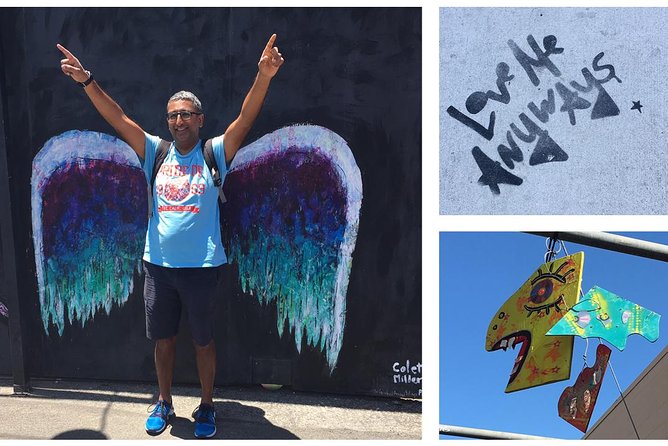
Next up is Colette Miller GlobalAngelWingsProject, a short stop designed as a quick visual reset. The title alone tells you what to look for, and the best part is how easy it is to register the moment without needing a long explanation.
Even though this is brief, it works in the flow. It is like a punctuation mark between mural-heavy zones. It also gives you a chance to step back, check your surroundings, and get ready for the more gallery-like stops.
If you like art that you can recognize instantly, this is a good one. If you prefer only large mural walls, you might find this one short, but the placement is smart.


Stop 3: Joel Bloom Square, a Beautiful Stop for Looking Closely
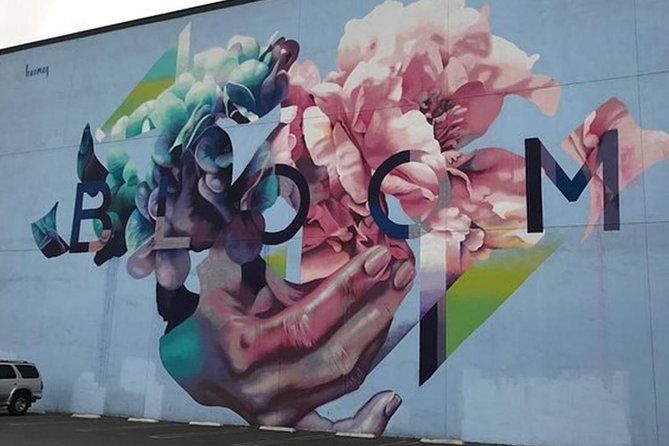
Then you hit Joel Bloom Square for See the Beautiful Bloom. This is another short stop, about 5 minutes, but that is exactly why it is effective. It keeps the tour moving while giving you a distinct visual theme.
A square stop also changes your viewing angle. Instead of scanning long walls, you tend to look at how the art sits in a more open public space. That is a nice contrast on a tour that spends a lot of time with street-level art surfaces.
Think of this stop as a palate cleanser. You get a moment that feels more composed than the denser mural areas.
Stop 4: Art Share L.A., Where Community Energy Shows
After that, you move to Art Share L.A., a stop planned for about 15 minutes. This is described as an art collective with an amazing gallery, and that wording matters because it signals what kind of space it is.
Collective spaces often feel different from big institutional rooms. You are more likely to see how artists and community ties shape what gets displayed. Even with a limited time window, you can still get a sense of how active the local scene is.
What I like here: it gives you a break from only murals outdoors. You get a different kind of attention span, a calmer environment where you can focus on the works instead of the streets.
Stop 5: Hauser & Wirth, Major Gallery Attention Without the Big Detour
Next is Hauser & Wirth, with about 20 minutes planned. This is where the tour expands beyond street art and into a recognizable, higher-profile gallery setting.
This stop is valuable for a simple reason: it shows you how art-world institutions can exist right inside the same neighborhood story as murals. You do not have to treat street art and gallery art as separate universes. The district can connect them.
Potential consideration: if you are hoping for deep, long explanations inside a gallery, 20 minutes is not a full museum experience. It is enough for a first pass with context, but it is not enough to become a scholar on the spot.
Stop 6: The A+D Architecture and Design Museum (When It’s on the Schedule)
The final planned stop is A+D Architecture and Design Museum, scheduled for about 20 minutes, but it is explicitly dependent on the day and time. That kind of flexibility is both a blessing and a heads-up.
When it works, you get a nice extension from visual art to design thinking. Architecture and design connect to the way the built environment shapes what you experience in a neighborhood like the Arts District. You can start linking murals and street art to the larger idea of how spaces communicate.
When it does not line up, the tour still functions, because the main story is built around the other stops. But you should know it is conditional.
Why the Tour Feels Personal: You Ask, You Notice, You Go Deeper
This is a private tour, which changes how the guide can respond. Instead of a scripted pattern, you get a more conversational pace. You can ask why a specific technique is used, or how the area’s layers connect.
The guide on this tour style, Ms. Lisa, is repeatedly associated with a great balance: she focuses on how the works are made and what the murals reveal about LA’s evolution. That approach helps you go beyond surface-level viewing. You end up noticing technique, materials, and the way the neighborhood history shows up in the art choices.
Small tours can also mean better energy. You are not constantly negotiating around a crowd, and that makes street art viewing more satisfying.
If you want a tour that helps you get your bearings fast in your first days in Los Angeles, this is the right format.
Practical Tips for a Smooth Arts District Walk
Keep it simple and you will enjoy the experience more:
- Bring a fully charged phone for the mobile ticket.
- Wear comfortable shoes. You are walking between multiple stops over about two hours.
- Plan for good weather. The tour requires it, and outdoor mural viewing can change if conditions are bad.
- If you care about photo-heavy stops, give yourself a few seconds extra at the mural areas so you do not feel rushed.
- If you are using transit, give yourself a little buffer to be at the meeting point at 714 Traction Ave on time.
Also, if you are sensitive to crowds, this route design is a win. It is built around a local-feeling route through murals and galleries rather than only the most obvious tourist circuits.
Who This Tour Is Best For
This Los Angeles Arts District tour fits best if you:
- love street art and want to understand it in context
- want a neighborhood orientation without committing to a full day
- prefer a private, question-friendly experience
- like mixing outdoor mural viewing with quick gallery moments
It may be less ideal if you:
- want long museum time inside major institutions
- dislike weather-dependent plans
- expect a deep lecture-style history session for every stop
For most people who want an authentic first taste of downtown LA’s art scene, it hits a practical sweet spot.
Should You Book This Los Angeles Arts District Tour?
Yes, I would book it if your goal is to see murals, pop into notable galleries, and learn how the neighborhood’s past shows up on its walls. The $50 price makes sense for a private route with free listed admissions at the stops, plus bottled water.
I would only pause if you are traveling in unpredictable weather, or if you expect long time inside the biggest gallery spaces. But if your timing and expectations match, this is a strong, efficient way to experience the Los Angeles Arts District the way locals tend to talk about it, through art and place in the same breath.
FAQ
How much does the Los Angeles Arts District Tour cost?
It costs $50.00 per person.
How long is the tour?
The tour lasts about 2 hours.
Is this tour private or shared?
This is a private tour/activity, so only your group participates.
What language is the tour offered in?
The tour is offered in English.
Where does the tour start and end?
It starts at 714 Traction Ave, Los Angeles, CA 90013, USA, and it ends back at the meeting point.
Is bottled water included?
Yes. Bottled water is included.
Do I need good weather?
Yes. The experience requires good weather. If it is canceled due to poor weather, you will be offered a different date or a full refund.
What is the cancellation policy?
You can cancel for a full refund if you cancel at least 24 hours in advance of the experience start time. Any changes made less than 24 hours before start time are not accepted, and cancellations within 24 hours are not refunded.
More Tours in Los Angeles
More Tour Reviews in Los Angeles
Not for you? Here's more nearby things to do in Los Angeles we have reviewed








Los Angeles City Tours, compared.
 ★ 4.6Warner Bros. Studio Tour HollywoodFrom $767,191 reviews
 ★ 5.0Full-Day Iconic Sights of LA, Hollywood, Beverly Hills, Beaches and MoreFrom $996,147 reviews
 ★ 5.0Full-Day LA Tour: Santa Monica, Hollywood and Beverly HillsFrom $952,431 reviews
 ★ 3.7Hop-On Hop-Off Bus Tour with Audio GuideFrom $512,030 reviews
 ★ 5.0Half Day Best of Los Angeles Guided City TourFrom $691,966 reviews
 ★ 4.7Half-Day Best of LA TourFrom $591,778 reviews
 ★ 5.0Shared 3 Hour Los Angeles TourFrom $501,686 reviews
 ★ 4.1Hollywood & Celebrity Homes Open-Air Bus TourFrom $291,624 reviews